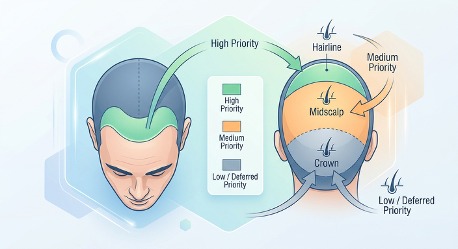

When planning a hair transplant, one of the most critical decisions you and your surgeon will make is how to distribute your available grafts. Donor hair, usually taken from the back and sides of your head, is a finite resource. You only have a limited number of healthy follicles to use over a lifetime, which means graft prioritization is everything. If you place too many grafts in the front, you might run out of hair for the crown. If you spread them out too thinly everywhere, you risk achieving density nowhere. At Long Hair Center in Istanbul, we evaluate every patient’s unique pattern of hair loss, age, and future hair loss potential to create a strategic design. Here is how graft prioritization works across the hairline, midscalp and crown and how we decide where your grafts should go first. Your hairline is the most visible part of a hair restoration. Even a small amount of density placed strategically along the front can completely transform your appearance and create the illusion of a full head of hair. Why it matters: The eye naturally looks at the face first. A strong natural-looking hairline frames your features and defines your facial symmetry. Beyond framing your face, a well-designed front line anchors your entire appearance, restoring natural proportions, boosting everyday self-confidence, and ensuring people see your overall expression rather than focusing on hair loss. Prioritization Level: In almost all cases, the hairline takes precedence during surgical planning. Because your donor supply is a finite resource, securing the front zone first guarantees the highest visual impact and ensures that your long-term aesthetic framework is safely established from the very first session. We design hairlines that look age-appropriate and natural. Creating a dense, irregular front zone ensures that when you look in the mirror, the immediate visual impact is one of restoration. Even if the areas behind the hairline have less density, a solid front row anchors the entire result. The midscalp is the area sitting between your hairline and your crown. It acts as a bridge and requires careful blending so the transition looks seamless. Why it matters: If you rebuild a dense hairline and a thick crown but leave the midscalp empty, your hair will look unnatural. Prioritization Level: Moderate to high. The midscalp requires a balanced approach. Because it is a larger surface area, it can consume a lot of grafts if you aren’t careful. We use meticulous placement techniques to create adequate coverage without depleting the supply needed for the front or back. Through strategic graft distribution and multi-angle placement, we harness natural hair layering to achieve full visual coverage, ensuring a seamless flow that ties your entire restoration together. The crown is the circular area at the back of the head. Hair loss here often starts as a thinning patch and can expand outward over time. Why it matters: The crown has a swirling hair growth pattern, which is optically difficult to cover. It requires a high volume of grafts to look dense because light reflects off the scalp easily from multiple angles. Additionally, the scalp tissue in the crown naturally has a lower blood circulation compared to the frontal and midscalp regions. This reduced microcirculation means that hair follicles receive fewer nutrients, making precision in depth and angle critical during implantation to ensure high graft survival and a natural, healthy growth direction. Prioritization Level: While a crown patch can be frustrating, treating it too aggressively early on is generally avoided because prioritization changes from person to person depending on your overall donor area capacity and individual aesthetic priorities. Because hair loss is a progressive condition, rushing to cover the crown can deplete the vital reserves needed for the front, meaning graft distribution must always be customized to your unique profile. While a bald crown can be frustrating, prioritizing it over the hairline is usually not a strategically logical decision. Furthermore, because hair loss is progressive, treating a crown too aggressively early on can leave you vulnerable if your hair loss spreads further behind it. We often advise saving crown restoration for a second session at least 10 months later, or using conservative graft counts to ensure a natural look that ages well with you. When you consult with our specialists at Long Hair Center, our doctors look at several guiding principles to map out your surgery: Hair loss doesn't stop just because you get a transplant. If you are younger, we must preserve donor hair for future recession. The thickness, laxity, and total count of your donor area dictate how many grafts we can safely harvest without over-harvesting. Coarse, curly, or wavy hair provides better optical coverage, meaning you might need fewer grafts than someone with fine, straight hair. It depends entirely on your specific hair loss grade and the health of your donor area. If we try to spread your limited grafts across all three zones at once, you might end up with thin, sparse coverage everywhere instead of a thick, natural look. For advanced hair loss, a step-by-step strategy, focusing heavily on the front and midscalp first, is usually the safest choice. This guarantees strong, dense results where they matter most, leaving the option to address the crown in a future session once your overall look is secured. The crown is an optical illusion zone that requires a massive amount of grafts to achieve solid coverage. If we use all your grafts on the crown and your hairline recedes further later on, your overall look will be unbalanced. Prioritizing the face-framing zones always yields a more aesthetically pleasing result. Maximizing your donor hair requires an artistic eye and strict medical precision. At Long Hair Center, we specialize in designing customized graft distributions that look natural, age gracefully, and make the most of your unique donor supply. Are you wondering how your grafts should be prioritized? Contact us today for a free, personalized consultation with our expert team in Istanbul, and let us help you map out your journey to a restored hairline. Hairline, Midscalp, Crown or Temples: Where Should Your Grafts Be Prioritized?
1- The Hairline: The Frame of the Face
The Long Hair Center Approach
2- The Midscalp: The Transition Zone
The Long Hair Center Approach
3- The Crown (Vertex): The Finishing Touch
The Long Hair Center Approach
Key Factors That Determine Your Graft Strategy
Your Age and Future Hair Loss
Donor Hair Capacity
Hair Characteristics
Can I Treat All Three Areas (Hairline, Midscalp, and Crown) Including Temples in One Session?
Why Do Doctors Often Leave the Crown for Last (2nd Session)?
Plan Your Restoration with Long Hair Center
Hairline, Midscalp or Crown Where Should Your Grafts Be Prioritized